 MCAS IWAKUNI
Please Read this Privacy and Security Notice
|
|
||
|---|---|---|---|
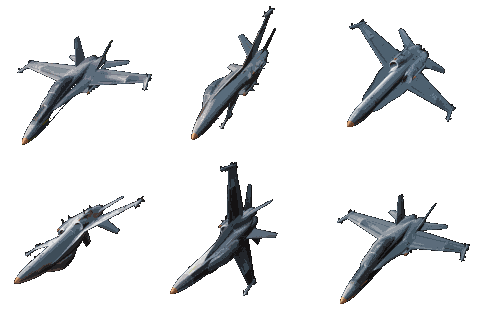
| F/A-18A/C/CN Hornet |
|
||
| Primary function:
Intercept and destroy enemy aircraft under all-weather conditions and attack and
destroy surface targets. Manufacturer: McDonnell Douglas Propulsion: Two General Electric F404-GE-400 afterburning, low bypass turbofan engines Thrust: 16,000 pounds per engine Length: 56 feet (17.06 meters) Wing span: 37.5 feet (11.43 meters) Cruise speed: High subsonic to supersonic Ferry range: Over 2,000 nautical miles (2300 miles) Combat radius: Fighter mission: 400 nautical miles (460 miles) Attack mission: 575 nautical miles (661.25 miles) Armament: Nine external wing stations, comprising two wingtip stations for an assortment of air-to-air and air-to-ground weapons, including AIM-7 Sparrows, AIM-9 Sidewinders, AMRAAMs, AGM-84 Harpoons and AGM-65 Maverick missiles; two inboard wing stations for external fuel tanks or air-to-ground stations; two nacelle fuselage stations for Sparrows or AN/AAS-38 Forward Looking Infrared Radar (FLIR) pods; and a center station for fuel tank or air-to-ground weapons. Air-to-ground weapons include GBU-10 and -12 laser guided bombs, Mk 80 series general purpose bombs, and CBU-59 cluster bombs. AN M61 20mm six-barrel gun is mounted in the nose and has a McDonnell Douglas director gunsight. Crew: 1 Introduction date: March 1983 Unit Replacement Cost: $28,100,000 Mission: Specific F/A-18A/C/CN tasks include: - Intercept and destroy enemy aircraft in conjunction with ground or airborne fighter control under all-weather conditions. - Conduct day and night close air support under the weather. - Conduct day and night deep air support, under the weather. Deep air support consists of radar search and attack, interdiction, and strikes against enemy installations using all types of weapons compatible with assigned aircraft. - Conduct armed escort of friendly aircraft. - Be able to operate from aircraft carriers, advanced bases, and expeditionary airfields. - Be able to deploy or conduct extended range operations employing aerial refueling. Features: The Marine Corps F/A-18A/C/CN strike fighter multi-mission aircraft was designed to replace the F-4 Phantom. The F/A-18A/C/CN Hornet is missionized for traditional fighter, attack, and close air support roles through selection of external pods/equipment to accomplish specific mission objectives. Any aircraft can quickly be configured to perform either fighter or attack missions, or both, thus providing the Marine Air Ground Task Force (MAGTF) commander more flexibility in employing his tactical aircraft in a rapidly changing scenario. Marine F/A18s may be land-based from prepared airfields, or they can operate from expeditionary airfields (EAF). They may also be sea-based, operating from the decks of Navy aircraft carriers. Inventory: 10 active and 4 reserve squadrons with 12 planes each for a total of 168 planes. Background: Operation Desert Storm in 1991 was the operational proving ground for the F/A-18A/C. Six single-seat F/A-18A/C squadrons deployed to SWA to participate in combat operations. These squadrons flew in excess of 4600 sorties for a total of 8864 hours while experiencing no combat losses. |
|||